Showing posts with label terrorism. Show all posts

Tuesday, 13 November 2018

What I learned on Bourke Street

It was another big weekend here.

Long-time readers (I must have some, right?) may remember that I have a firm view that the old civil defence skill-sets are more vital than ever in the age of terror. This weekend just gone I found myself forming part of just such a response, following the terror attack on Bourke Street last Friday.  An event like that tends to shock people far beyond the immediate zone of impact: Bourke Street is a major thoroughfare and a great many people will have a feeling of "I could have been there"


Because of the impact on the public at large, Red Cross Emergency Services was asked to attend the CBD with our friends from the Victorian Council of Churches and provide psychological first aid to anyone who might need it.  I volunteered for the Saturday morning shift and cancelled my barre class.  I was up at 7am and after a breakfast of pita bread and cream cheese headed over to the Red Cross premises in North Melbourne for a briefing.

That moment when you think "God, do I really look that awful?"

Our task was to patrol up and down Bourke Street, identify people who had witnessed the attack (shop workers and the homeless, for example) and anyone otherwise in distress and to provide sympathy and support.  Briefings were conducted by Victoria Police and the City of Melbourne.  I probably shouldn't share details of what was discussed with people, but I can tell you that there quite  a lot were rattled by what they had seen or been close to.  No wonder either: it's asking a bit much of a young woman in a boutique to take her own brush with the War on Terror in her stride.


At about 10:30 we were redeployed to Pellegrini's, a cafe on Bourke Street.  Pellegrini's is very popular.  Nearly everyone who has reason to be in Melbourne's CBD has had dinner there or at least coffee from there (including me).  It turned out its part owner had been killed in the attack.  That was what struck close to home for many people: it's different when a part of the landscape of one's life vanishes in a moment of violence.  People began to lay flowers at the door of the cafe and there were many truly distressed people waiting to sign a condolence book.


When we were sent for lunch at 12:30 I was surprised to find how emotional I'd become, even though I couldn't identify the emotion or the cause.  I don't believe that empathy is a virtue.  If it is, it's a valueless one: it helps nobody for me to "feel their pain"; all that matters is that I take action to alleviate it.  Regardless, we must have been doing something useful since the police and the City of Melbourne seem to have been grateful Red Cross and VCC were there.

Our shift was meant to end by 2pm but continued on till 3:30pm including debrief.  As a result, I was going to be too late to get to the starting line for the Portsea Half-Marathon and regretfully withdrew from the race.  I still wanted a run and stopped in Frankston to get one in and hopefully burn off the emotions of the day.  In the event I knocked out 15 kilometres including two trips up Oliver's Hill.  For the first time ever, I found I actually felt worse post run: as foetid and hollow as an old rotting mattress.
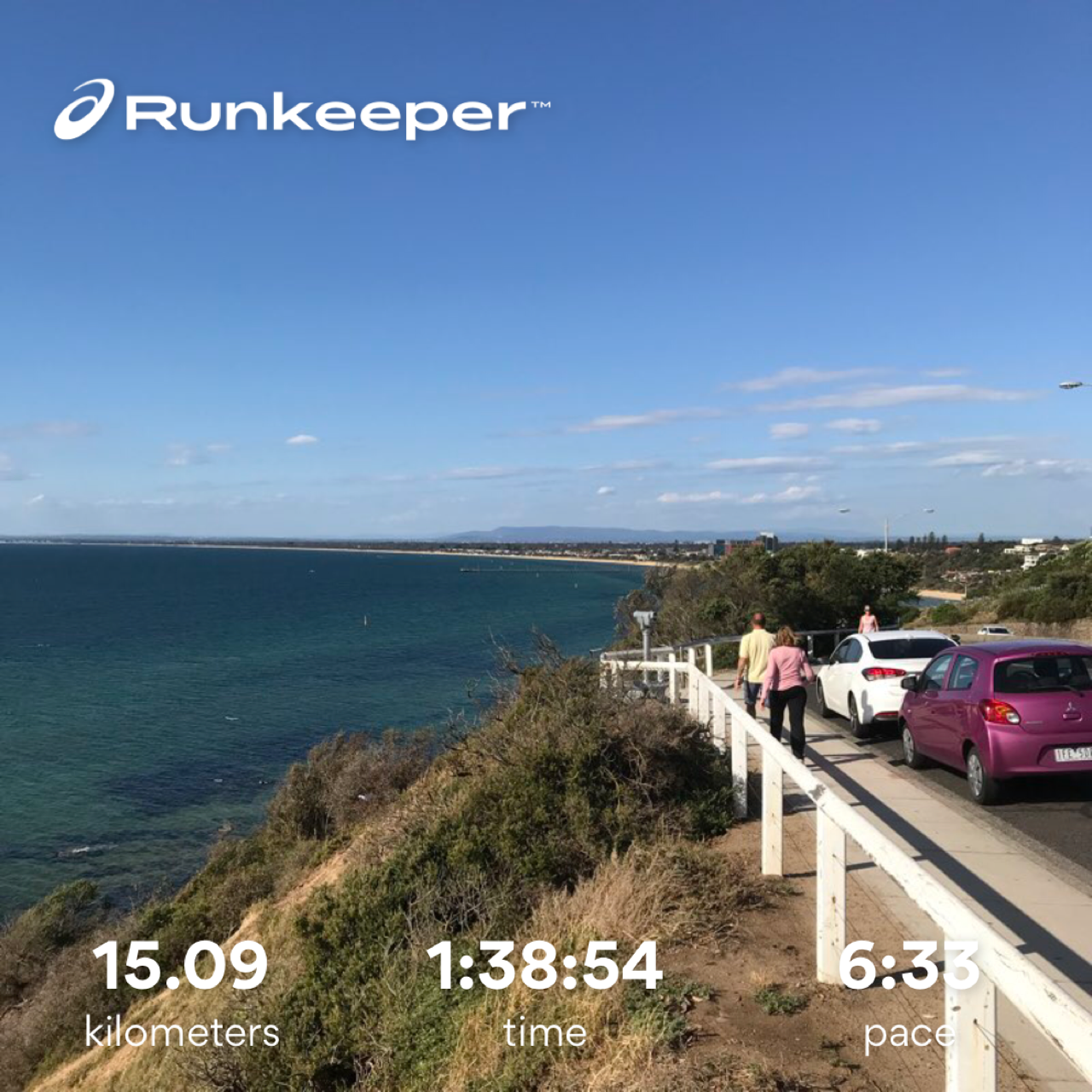
View from Oliver's Hill, Frankston
This was a remarkably annoying state of affairs and so I drove on to Shoreham where I was meeting with the old boy to get some farm work done with him and Barry (a close friend): I reasoned that what running couldn't fix, alcohol and a good night's sleep probably would.  I'm not sure the old boy really "got" why Red Cross was doing what it was doing today.  Noting how welfare has usually been presented in the civil defence universe, this may not be incomprehensible:


Be all that as it may, there was work to do and I lent a hand.  That's the key thing.  At any rate, it felt good to crash out to sleep at 11pm

I woke again nine hours later(!) feeling warm, rested and safe.  I was a little struck by how much this last actually meant to me.  The day was that coastal combination of warm sun and cool breeze that is a reason to be alive.  The bay was as flat as glass and I recall thinking it might have been a good day for fishing.  The day itself passed well with farm work and ended with fish and chips which I hadn't had in quite a while.

Westernport Bay with Philip Island in background
On any measure it was a weekend to remember. Some people were helped, at least, and I learned something about people and about myself.

Friday, 17 June 2016

Orlando and Paris

I've been trying to think of something worth saying about the spate of jihadist killings in Florida and France.  It's harder than one would think.  People have taken predictable positions: progressives blame guns and conservatives blame Islam.  My feeling is very much what it was after the San Bernardino shootings: the cause isn't important, and the means even less so, but being able to do something about the consequence certainly is.

I struggle to make sense of these attacks on their own terms or any other.  In each case the offender couldn't really be called a madman.  Each one seems to have been aware that he was killing a nightclub full of human beings, or two police personnel, rather than (say) because he believed either was persecuting him particularly (I'm happy to be corrected on the point, of course).  Both men considered themselves to be acting for a cause larger than their own desires or grievances, which means one can't really say they were simply criminals like Martin Bryant or Al Capone.

Acts of war then?  This isn't a terribly satisfactory description either.  Certainly, indiscriminate killing has been used in warfare for millennia, but even when it was intended to spread terror, it was for reasons which were rational, at least in their own terms (barbaric and evil on anyone else's).  At the trial of Radovan Karadžić for crimes committed during the Bosnian War -
The Judges also found that between April 1992 and November 1995 Karadžić participated in a [Joint Criminal Enterprise (JCE)] to establish and carry out a campaign of sniping and shelling against the civilian population of Sarajevo, aimed to spread terror among the civilian citizens (Sarajevo JCE).
During this period the Army of Republika Srpska (VRS) deliberately sniped and shelled civilians in Sarajevo on an almost daily basis throughout the conflict. “Sarajevo civilians were sniped while fetching water, walking in the city, and when using public transport.  Children were sniped at while playing in front of their houses, walking with their parents or walking home from school” said the Presiding Judge Kwon.
The Chamber found that Karadžić significantly contributed to the Sarajevo JCE, both as the highest political authority in RS and Supreme Commander of the VRS. Having control over the VRS throughout the conflict, he was directly involved in military matters in Sarajevo and issued many orders at the strategic and at the operational level. Karadžić used the campaign of sniping and shelling, causing terror among the civilian population in Sarajevo, as a means of exerting pressure on the Bosnian Muslim leaders and the international community in pursuit of his political goals.
The judges concluded that Karadžić is guilty of unlawful attacks on civilians, murder and terror.
Even the Nazi obliteration of the village of Lidice at least had a discernible purpose - the punish the assassination of Reinhard Heydrich and and to deter further attacks (as an aside, forgetting that event rendered Quentin Tarantino's Inglourious Basterds an unforgivable lèse-histoire; in reality, the sequel to the film would have been about Albert Speer and Dietrich von Choltitz carrying out the Nero Decree).

But Orlando and Paris?  Even the most committed jihadist can't have imagined that even a double-digit bodycount carried enough terror to make gay people in America deny their sexuality?  That killing two police officers bring the French state to a grinding halt?  Ninety-four years have passed since the very early horror film Nosferatu.  I suspect our culture is no longer so easily terrified (as opposed to being shocked, startled, or stirred up to great whirling gusts of emotion).

I think the real explanation is in the dead bodies of the attackers: Like Herostratus burning down the Temple of Artemis, their crimes were a means of securing both their own death and their place in a pantheon of heroes.  Both conservatives and liberals, then, are wrong in their response.  Conservatives blaming Islam are at best blaming an accelerant for an already burning fire.  Liberals blaming guns concede that the killings must simply be lived with and that the only interesting issue is means.  And out here in the real world where real people turn up to face real weapons and tend real casualties, both sides are as irrelevant as shit.  Real problems crave real solutions: stop the person doing the killing if you can, and bind the wounds of the injured where you can't.  Nothing else matters.

Wednesday, 23 March 2016

After Brussels

Only a short post this afternoon.  This story from AP was emailed to me by FindLaw earlier today -
French officials are condemning the Brussels attacks in the strongest terms.
Prime Minister Manuel Valls, speaking after a crisis meeting called by the French president, says "we are at war. We have been subjected for the last few months in Europe to acts of war."
President Francois Hollande says "terrorists struck Brussels but it was Europe that was targeted” and all the world that is concerned."
Hollande also warned that "this war will be long" so sang froid and lucidity are needed.
Paris says it will light the Eiffel Tower in the colors of the Belgian flag. The city's mayor, Anne Hidalgo, described it in a tweet as a measure of "solidarity with Brussels."
To hear France speak of war, or considering itself at war, makes me uneasy.  That country paid a truly horrendous price in the First World War, with 6,100,000 casualties from a total mobilization of 8,400,000: a genuinely staggering casualty rate of 73.3%.


Image from here


France possesses a culture utterly filled with life.  When it speaks of war, and embraces death, I can only look on with a kind of horror that I find hard to explain.

Friday, 22 January 2016

National Security Resources Board, Survival Under Atomic Attack (Department of Civil Defence, Boston, 1951)

Disaster preparedness has been around pretty well since God said to Noah
The end of all flesh is come before me; for the earth is filled with violence through them; and, behold, I will destroy them with the earth. Make thee an ark of gopher wood; rooms shalt thou make in the ark, and shalt pitch it within and without with pitch.
It seemed to me that it might be interesting to look over what past generations have thought about responding to calamities (actual or potential) and see whether they recommended anything of value for us today.

Image from here
The first text I'm using for this is Survival Under Atomic Attack, prepared by America's National Security Resources Board in the early 1950s.  For myself, I don't view nuclear devastation as a particularly serious risk these days, notwithstanding North Korean sabre rattling.  However, we can derive some useful advice from this book.  When it comes to dealing with situations where a major explosion may occur (for example, certain types of truck accident), it advises that -
Even if you have only a second's warning, there is one important thing you can do to lessen your chances of injury by blast: Fall flat on your face.
More than half of all woundsare the result of being bodily tossed about or being struck by falling and flying objects.  If you lie down flat, you are least likely to e thrown about.  If you have time to pick a good spot, there is less chance of your being struck by flying glass and other things.
If you are inside a building, the best place to flatten out is close against the cellar wall.  If you haven't time to get down there [or don't have one at all!], lie down along an inside wall, or duck under a bed or table.  But don't pick a spot right opposite the windows or you are almost sure to be pelted with shattered glass.
If caught out-of-doors, either drop down alongside the base of a good substantial building  - avoid flimsy, wooden ones likely to be blown over on top of you - or else jump in any handy ditch or gutter.
The book also has some useful points to make where fire and explosion control is concerned.  It recommends 'fire-proof' housekeeping and not letting garbage or detritus build up around your home.  If a major shockwave is expected (whether from an explosion, seismic activity or any other cause), it would be priudent for you to know how to turn off the gas and electrical supply to your house.

What real or imagined disasters from the past do you feel may have something useful to tell us today?

Monday, 21 December 2015

First Aid brushup: Blast Injuries

Hi everyone,

What this is about

A while back I wrote about the need for a focus on well-organised civil defence as part of responding to the threat of terror.  With that in mind, I'm going to write a series of first-aid themed posts covering the sorts of injuries which might be expected in a terrorist incident, as these are (understandably) often only lightly covered in first aid courses.  This is the first such post.

Sources, Disclaimer and Legal Jiggery-Pokery

Unless otherwise stated, I'm taking this from Kym Eden, Fun with First Aid (11th ed., National First Aid, n.p., 2013).  While the book has a light-hearted style, it covers things in good detail.  

57502_Fun-with-First-Aid-Book-300

I should disclose that while I hold a first aid certificate, I am not a medical practitioner, nurse or paramedic (although I'd welcome any comments or contradictory opinions from people better qualified than me).  The advice I post is effectively unqualified and any liability you incur from following it is yours alone.  I strongly recommend that every person should seek formal first-aid training from a suitable agency in their jurisdiction.

Blast Injuries

Identification

The circumstances may make it obvious that the casualty has been injured by a blast.  However, the following will make clear that this has been the cause -
  1. Extensive multiple soft tissue injuries (shrapnel wounds).
  2. Fractures and Burns.  Burns will be fairly obvious.  Fractures can be identifed by severe pain at the location of the injury; the injury site may be deformed or bent at a strange angle, as well as being bruised or discoloured, swollen, inflamed and tender.  If a limb is affected, the casualty may be unable to move it.  The fractured bones may audibly grate together, and the casualty may report the limb to be numb or tingly.
  3. Coughing up of bloodstained fluids.
  4. Deafness or bleeding from the ears.
  5. Shock.  Shock is essentially the effect of significant internal or external blood loss.  Initially shock an be indicated by a raised heartrate and rapid breathing, and by pale or cold skin.  As it progresses, parts of the the casualty's body may start to have a grey-blue colour (if you squeeze their fingernail, the colour may take some time to return).  They may report being nauseous or may throw up.  They may also report feeling weak, dizzy, restless and thirsty.  If the condition worsens even further, they may become confused and disoriented, drowsy (and start yawning) and begin to slip into unconsciousness.  If untreated, death will result.
Management

For every casualty -
  1. Assess any danger in the area (for example, fire, downed power lines, unstable walls or ceilings, suspicious packages).  Do not place yourself in significant danger in order to help: nobody needs a dead hero.
  2. Send for help
  3. Identify and control any bleeding.
  • For external bleeding, place direct pressure on the wound, ideally with a clean pad.  Secure the pad in place with a bandage.  The bandage needs to be tight enough to keep the pressure on, but not so tight circulation is affected.  If a limb is affected, and if it is possible, lift the limb above the level of the heart to reduce the blood flow.  Reassure the patient so as to reduce their heart rate.  Ideally, you should never remove the first pad placed on the wound because this disrupts the blood-clotting process.  Consider instead placing a second pad on top of the first.
  • Internal bleeding may be suggested by the signs of shock, and also by blood emerging from any of the body's natural openings.  Internal bleeding cannot be treated by first aiders, save (where the patient is conscious) raising his or her legs to improve blood supply to vital organs.
Conscious patient
  1. Help the casualty into a comfortable position.
  2. If necessary and appropriate, loosen clothing around the casualty's neck, chest and waist to assist them to breathe.
  3. Keep the casualty warm (covered if necessary) and provide reasurance.
  4. Do not provide the casualty with food or drink as this may make later medical care (particularly administering anaesthetics) difficult.  If they become thirsty, moisten their lips with water.
Perform a "secondary survey" to identify further possible injuries.  Working from the head down -
  • Check for anything that suggests a head injury - lumps and bumps, swelling or minor wounds, and also discharges from the ears or nose.  Is the face swollen or discoloured, and have the eyes been affected?
  • Ask the patient to breath deeply to see if discomfort is caused to the neck, shoulders or chest.  Are there signs of swelling, inflammation or fractures.
  • In the patient can be log rolled, are there wounds or abnormalities to their back, and are they complaining of pain.
  • Check the arms and legs for abnormalities or injuries (and also check for any medicalert bracelets).
  • Check the abdomen and pelvis for pain, distension or incontinence
The ideal positions for casualties with certain injuries will be
  • Chest wound: Sitting upright, leaning forward and towards their injured side.
  • Abdominal wound: Lying on their back, with the head and shoulders raised on a pillow (or something similar) and the knees slightly bent (also supported by a pillow or something similar)
  • Burns: These injuries should be cooled and covered with non-adherent dressings. Cooling is best done with cool running water or compresses.
  • Fractures: These injuries should be supported and immobilised.
Unconscious patient

If the casualty is not breathing, check their airway for obstructions.  If they are still not breathing, perform cardiopulmonary resuscitation and use a defibrillator if one is available.

If the casualty regains consciousness, follow the instructions above.  If they remain unconscious but resume normal breathing, move them into the recovery position and attend to any other wounds they have.  If at all possible, remain with them and monitor their breathing and general condition.

Giveaway

I have a second-hand copy of the second edition of Kym Eden's book to give away.  Although it's out of date, there's still good material in it.  If you'd like to claim it, leave me a message in the comments.

Sunday, 6 December 2015

You can too: Responding to Terrorism

The recent attacks in Paris and San Bernardino fitted with what the West has learned about terrorism in the last 15 years.  They aimed at a broader goal than simple personal desire. This makes them different to the simple criminality of an Al Capone or a Martin Bryant.  The 'broader goal' means they can be considered an act of war.  This is the source of their terror.

As much as there is to condemn in human history, as a species we've been trying to do war better over the centuries.  Slaughtering non-combattants may have been permissible in 1209  and 1415.  It had the sanction of the laws of war in 1649.  But it had certainly become a crime by 1902.  I doubt anyone today would call the 1945 bombing of Dresden anything better than an evil necessity.  And nobody would try with a straight face to justify the massacre at My Lai.  Terrorism rejects the assumption that civilians should be safe.  What was regrettable in the past, and criminal at Taba and Srebrenica, becomes a positive plan.

What should we do in response?  I have more than a little sympathy for Nevada Congresswoman Michele Fiore's response:
My strong message to you is its time Americans begin protecting America. Get armed, get trained get your head out if the sand and be prepared.
I endorse Front Sight Firearms Training Institute in Pahrump, Nevada. I've been training there since 2009 and I implore you to take a class.
I'm not convinced, though, that it's a solution, or at least a complete solution.  Looking at the massacres conducted during the Holocaust, Clive James observed sadly that
... one of the main opponents of sanity is our own fantasy. In the wishful thinking that saps our thinking, we can’t help wondering why all those obedient victims didn’t gang up at a given signal and fight back with their bare hands, as we would have. In our minds we have mighty powers, like Steven Seagal: our hands are deadly weapons. But the hands of the murderers weren’t bare: they were holding rifles and machine pistols, and those really were deadly weapons. ... In Sobibor, the breakout was led by Russian soldiers who knew what they were doing. In the [Warsaw] ghetto, the insurgents were mainly untrained civilians. They took a heartening number of their tormentors with them, but that was it. The issue was already decided before the flame-throwers were brought in, and the tanks soon had nothing left to shoot at.
I don't know that I'd want to be my own or anybody else's last line of defence in the case of gunplay: if I had any plausible military value, I suppose the Army would have accepted my application to enlist.  I imagine that most people are in precisely the same position.  What's open to that rest of us is minimising the damage that terrorism can do.

I imagine the idea of civil defence has been around forever, but it seems to have burst into full flower in the Second World War.  It's probably more valuable now than ever, and it's especially instructive where terrorism is concerned.  A person who opens fire in a city street wants to cause injuries.  So consider learning how to respond, to look after savage flesh injuries and shattered bones.  The Red Cross and St John Ambulance can train you in first aid.  They'll be even happier if you support them in return.

Image from here

When a bomb is set off in a built up area, some injuries will come from a blast; others will come from falling buildings and structures.  You can be taught how to work with a team to make these scenes safe and to look for survivors.  In another time and place this was part of the work of the Auxiliary Fire Service.  Organizations carrying out urban search and rescue carry it on today.

Image from here

Poison has been an effective weapon of terror in recent memory.  The public needn't be helpless.  America's Office of Civilian Defence once sought civilians for this work, and today's volunteer firefighters are often trained to deal with Hazmat incidents.

Join now The office of civilian defense needs you for decontamination squads /
Image from here

I have no shortage of respect for the police and security services, but the nature of terror in our atomised age makes it inevitable some attacks will occur.  Not everyone is well suited to meet violence with force, but everyone is able in some way to minimise its impact.  If you can take the time to learn part of the civil defence skillset, you can be confident that if something happens, you can minimise the harm it causes.  And if disaster comes through accident or through nature, rather than through bombs or guns, you can be part of the effort to set things right.